The Political Functions of Khilʿat Investiture and Gift Diplomacy in the Qajar Era
DOI:
https://doi.org/10.61838/kman.jspsich.548Keywords:
Khilʿat Investiture, Gift Diplomacy, Qajar Era, Pishkesh, Political Rituals, Court Culture, Royal AuthorityAbstract
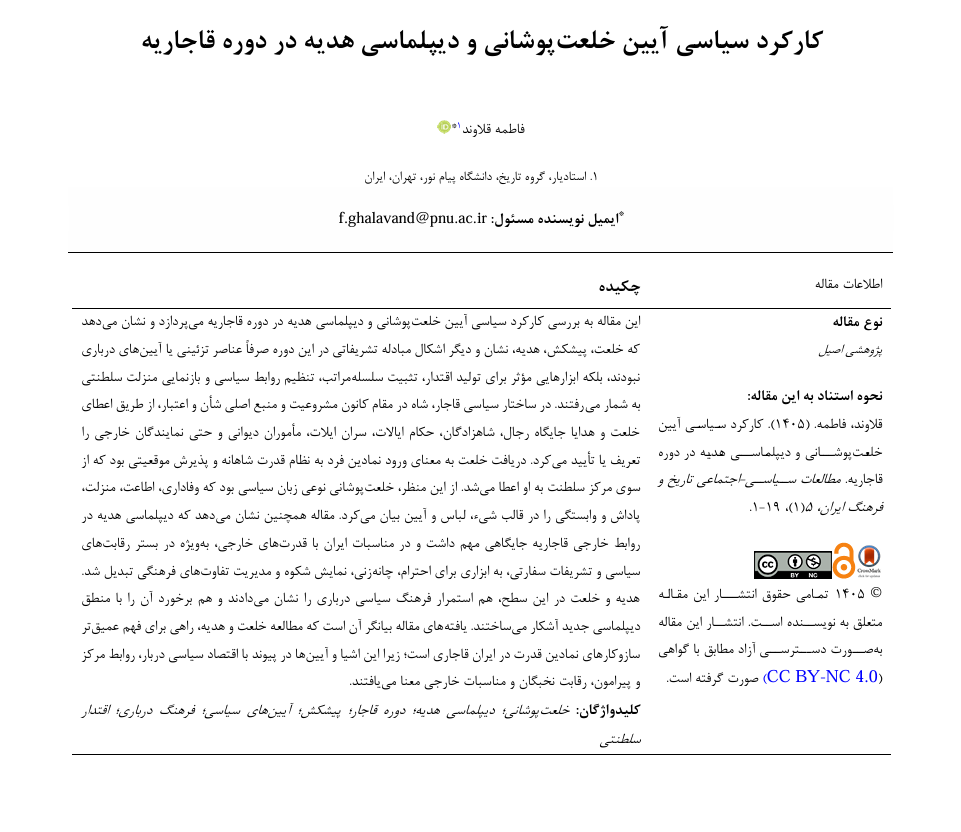
This article examines the political functions of khilʿat investiture and gift diplomacy in the Qajar era and argues that robes of honor, pishkesh, gifts, medals, and other ceremonial objects were not merely decorative elements of court culture, but effective instruments for producing authority, consolidating hierarchy, regulating political relations, and representing royal prestige. In the Qajar political order, the shah functioned as the central source of legitimacy, rank, and honor. Through the bestowal of khilʿat and gifts, he defined or confirmed the status of princes, courtiers, provincial governors, tribal leaders, administrative officials, and even foreign representatives. Receiving a khilʿat meant symbolic incorporation into the royal order and recognition of a position granted by the monarchical center. From this perspective, khilʿat investiture operated as a political language through which loyalty, obedience, status, reward, and dependency were expressed in the form of objects, clothing, and ritual performance. The article also demonstrates that gift diplomacy occupied an important place in Qajar foreign relations. In Iran’s interactions with foreign powers, especially within the context of political rivalry and diplomatic protocol, gifts became tools of respect, negotiation, ceremonial display, and cross-cultural management. At this level, gifts and robes of honor revealed both the continuity of courtly political culture and its encounter with the emerging logic of modern diplomacy. The findings indicate that the study of khilʿat and gift exchange provides a deeper understanding of the symbolic mechanisms of power in Qajar Iran. These objects and ceremonies acquired political meaning through their connection to the political economy of the court, relations between the center and the provinces, elite competition, and diplomatic encounters. Therefore, khilʿat investiture and gift diplomacy should be understood as active components of Qajar governance, not as passive remnants of tradition.
Downloads
References
Abtahi, S. A., & Karimi, N. (2016). The Place of Pishkesh in the Revenues of the Nasiri Era Based on Documents, 1848-1896. Sokhan-e Tarikh, 10(23).
Amanat, A. (1997). Pivot of the Universe: Nasir al-Din Shah Qajar and the Iranian Monarchy, 1831-1896. University of California Press.
Amin al-Dowleh, A. K. (1991). The Political Memoirs of Mirza Ali Khan Amin al-Dowleh. Amir Kabir.
Ashraf, A. (2016). The Politics of Gift Exchange in Early Qajar Iran, 1785-1834. Comparative Studies in Society and History, 58(2), 550-576. https://doi.org/10.1017/S0010417516000177
E'Temad al-Saltaneh, M. H. K. (1984). The Diary of E'temad al-Saltaneh. Amir Kabir.
Floor, W. M. (1998). A Fiscal History of Iran in the Safavid and Qajar Periods, 1500-1925. Bibliotheca Persica Press.
Floor, W. M. (1999). The Persian Textile Industry: Its Products and Their Use, 1500-1925. Association pour l'avancement des études iraniennes.
Floor, W. M. (2001). Gift Giving v. In the Qajar Period. Encyclopaedia Iranica (Vol. X, pp. 615-617).
Floor, W. M. (2017). Khil'at. Encyclopaedia Iranica.
Fraser, J. B. (1825). Narrative of a Journey into Khorasan in the Years 1821 and 1822. Longman, Hurst, Rees, Orme, Brown, and Green.
Ilchi, A. K. (1984). Hayrat-Namah: The Travelogue of Mirza Abolhasan Khan Ilchi to Europe. Amir Kabir.
Khormuji, M. J. f. (1965). Haqayiq al-Akhbar-i Nasiri. Zavar.
Khosh Ab, F., & Aghazadeh, J. (2025). Economic Functions of Khil'at and Khil'at-Bestowal in the Qajar Era: Based on Reports of Foreign Travelers. Historical Journal of Iran after Islam, 16(42), 55-83. https://doi.org/10.22034/jiiph.2024.61228.2511
Lambton, A. K. S. (1994). Pishkash: Present or Tribute? Bulletin of the School of Oriental and African Studies, 57(1), 145-158.
Mahmoud, M. (1974). The History of Political Relations between Iran and Britain in the Nineteenth Century. Eqbal.
Morier, J. J. (1812). A Journey through Persia, Armenia, and Asia Minor, to Constantinople, in the Years 1808 and 1809. Longman, Hurst, Rees, Orme, and Brown.
Mostawfi, A. (1963). The Story of My Life; or, The Social and Administrative History of the Qajar Period. Zavar.
Naser al-Din Shah, Q. (2010). The Diary of Nasir al-Din Shah Qajar. Sokhan.
Rahmani Ghourtani, M., Mohammad Khani, S., & Dehghannezhad, M. (2013). An Introduction to Bribery, Pishkesh, and Its Types in the Qajar Period: With Emphasis on the Nasiri Period. Jelve-ye Honar, 23(17), 127-153. https://doi.org/10.22051/hii.2014.728
Sepehr, M. T. (1998). Nasikh al-Tawarikh: The History of the Qajars, from the Beginning to the End of the Reign of Fath-Ali Shah. Asatir.
Shamim, A. A. (1992). Iran under Qajar Rule. Modabber.
Shirazi, M. S. (1968). The Travelogue of Mirza Saleh Shirazi. Tahuri.
SyedBonakdar, S. M., & Kamalvand, M. (2019). An Examination of the Role and Status of Orders and Medals of the Qajar Era in the Foreign and Domestic Relations of This Period. Studies in Islamic History, 11(41).
SyedBonakdar, S. M., & Mohammadi Aeen, S. (2025). Khil'at and Its Functions in the Court Relations of Nasir al-Din Shah Qajar, 1848-1896. History of Islam. https://doi.org/10.22081/hiq.2024.69338.2397
Wills, C. J. (1893). In the Land of the Lion and Sun; or, Modern Persia. Ward, Lock & Bowden.
Downloads
Publication Timeline
- Submitted
- Revised
- Accepted
Issue
Section
License
Copyright (c) 2026 Fatemeh Ghalavand (Corresponding Author)

This work is licensed under a Creative Commons Attribution-NonCommercial 4.0 International License.