Factors Affecting Human Trafficking in Sistan and Baluchestan Province
Keywords:
Human trafficking, Organized crime, National security, Criminal budgeting, Illegal immigrationAbstract
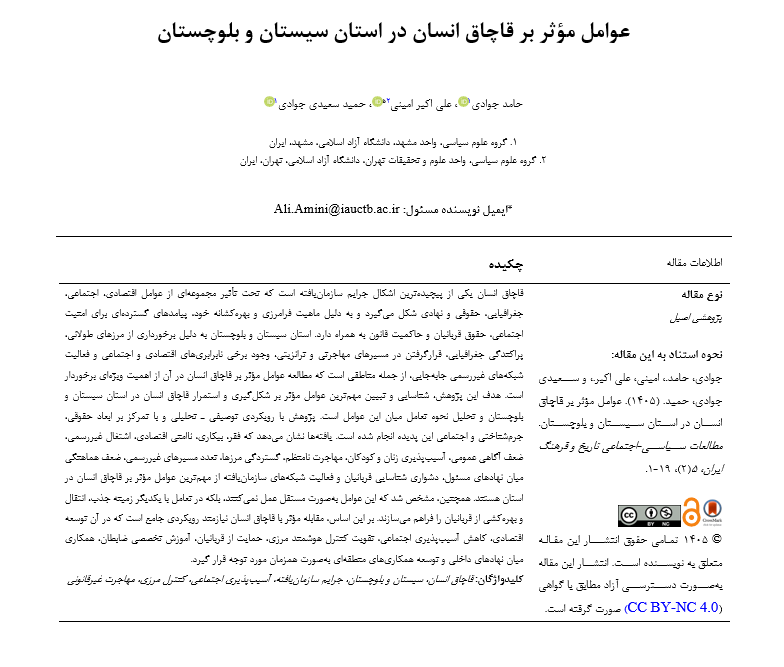
Human trafficking is one of the most complex forms of organized crime and is shaped by a combination of economic, social, geographic, legal, and institutional factors. Due to its transnational and exploitative nature, it produces serious consequences for social security, victims’ rights, and the rule of law. Sistan and Baluchestan Province is particularly important in this regard because of its extensive international borders, geographic dispersion, location along migration and transit routes, socioeconomic disparities, and the presence of informal cross-border movements. This study aimed to identify and explain the major factors contributing to the emergence and persistence of human trafficking in Sistan and Baluchestan Province and to analyze the interaction among these factors. The study adopted a descriptive-analytical approach with a focus on the legal, criminological, and social dimensions of human trafficking. The findings indicated that poverty, unemployment, economic insecurity, informal employment, limited public awareness, the vulnerability of women and children, irregular migration, extensive border areas, multiple unofficial routes, insufficient coordination among responsible institutions, difficulties in identifying victims, and the operation of organized criminal networks are among the most important factors contributing to human trafficking in the province. The findings also demonstrated that these factors do not operate independently; rather, they interact and reinforce one another, thereby creating conditions that facilitate the recruitment, transportation, control, and exploitation of victims. The study concludes that an effective response to human trafficking requires a comprehensive and coordinated strategy that simultaneously addresses economic development, reduction of social vulnerability, intelligent border control, victim identification and protection, specialized training of law-enforcement authorities, interagency coordination, and regional cooperation.
Downloads
References
Assar, M. T., & Bayabani, G. (2007). International Human Trafficking and Its Consequences. Karagah(1), 76-103.
Bonyadi, M. (2010). A Comparative Study of Human Trafficking in Criminal Law Shahid Ashrafi Esfahani Higher Education Institute, Department of Criminal Law and Criminology].
Eyni, M. (2011). Protection of victims of human trafficking in transnational documents. Legal Studies(5), 139-173.
Habibzadeh, M. J., Moghaddasi, M. B., & Jafari Dowlatabadi, A. (2009). Human Trafficking in Iranian Criminal Law. Comparative Law Research, 13(4), 99-123.
Hopper, E. K. (2024). Human Trafficking Prevention: Using a Socioecological Framework to Moderate Risk and Promote Protective Factors. 9-51. https://doi.org/10.1037/0000379-002
Koulayi, E. (2007). HUMAN TRAFFICKING IN CENTRAL ASIA. The Quarterly Journal of Politics, 37(4).
Mo'tamedī, H., & Mostūfī Far, F. (2009). Human Trafficking.
Nourmohammadzadeh, A. (2024). Criminalization of Human Trafficking as an Organized Crime. Quarterly Journal of Internal Security Studies and Research, 2(6).
Shayegan, F. (2010). Global Community Measures to Combat Human Trafficking. Journal of International Police Studies(3), 5-26.
Sheikh al-Islami, M. H., & Khorrami, M. (2014). Examining the Measures of the Economic Cooperation Organization (ECO) to Combat Human Trafficking as a Global Issue. Central Eurasian Studies, 7(2), 291-318.
Thammasiri, K. (2024). Current Trends in Human Trafficking and the Effectiveness of Law Enforcement Strategies in Combating Sex Trafficking in Thailand. Studies in Social Science & Humanities, 3(7), 12-18. https://doi.org/10.56397/sssh.2024.07.02
Wiener, R. L., Wiener, S. M., Haselow, R., McBride, B. B., & Sircy, K. R. (2024). Emotion Regulation Reduces Victim Blaming of Vulnerable Sex Trafficking Survivors. Law and Human Behavior, 48(4), 281-298. https://doi.org/10.1037/lhb0000572
Zaghei, A. (2009). A Study of the Capacity of the International Criminal Court to Address the Crime of Human Trafficking. Legal and Political Research, 11(26).
Zagheli, A. (2015). Human Trafficking in Iran's Criminal Policy and International Instruments (2nd ed.). Mizan.
Downloads
Publication Timeline
- Submitted
- Revised
- Accepted
Issue
Section
License
Copyright (c) 2025 Hamed Javadi (Author); Ali Akbar Amini (Corresponding Author); Hamid Saeedi Javadi (Author)

This work is licensed under a Creative Commons Attribution-NonCommercial 4.0 International License.