Collapse of Constitutional Institutions and the Emergence of Sultanistic Authority in the Early Pahlavi Period
DOI:
https://doi.org/10.61838/kman.jspsich.521Keywords:
Organizational modernization, Sultanate regimes, Reza Shah, Constitutional institutions, State modernization, AuthoritarianismAbstract
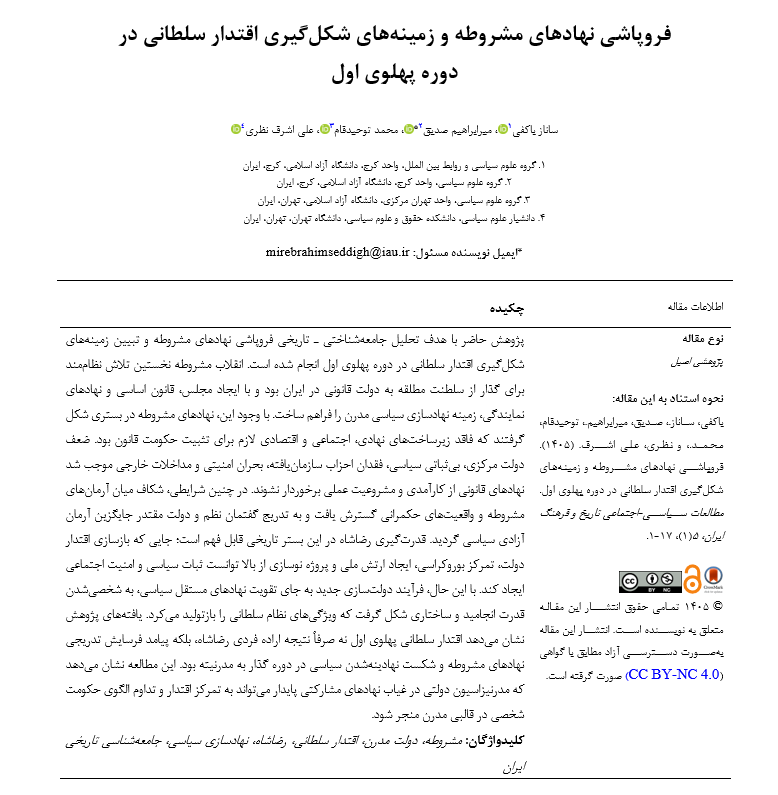
This study provides a historical–sociological analysis of the collapse of constitutional institutions and the emergence of sultanistic authority during the early Pahlavi era in Iran. The Constitutional Revolution represented the first systematic attempt to transform absolutist monarchy into a rule-based political order through the establishment of parliament, constitutional law, and representative institutions. Despite these institutional innovations, constitutionalism developed within a socio-political environment lacking the structural foundations necessary for durable institutionalization. Weak state capacity, political instability, absence of organized political parties, security crises, and foreign intervention undermined the effectiveness of constitutional governance and gradually eroded public confidence in parliamentary rule. As the gap widened between constitutional ideals and governing realities, political discourse increasingly shifted from demands for liberty toward calls for order and centralized authority. The rise of Reza Shah must therefore be understood within this broader historical context. Through military consolidation, bureaucratic centralization, and state-led modernization, the new regime restored stability and strengthened state capacity. However, modernization was accompanied by the personalization of political power, transforming formal institutions into instruments of executive authority and producing a political structure consistent with sultanistic rule. The findings suggest that Pahlavi sultanism emerged not merely from individual ambition but from the gradual institutional erosion of constitutionalism and the incomplete process of political institutionalization during Iran’s transition to modernity. The study demonstrates that state modernization without autonomous political institutions can reinforce centralized authority while reproducing personalized governance within modern administrative forms.
Downloads
References
Abrahamian, E. (2001). Iran Between Two Revolutions. Ney Publishing.
Adamiyat, F. (1978). Thoughts of Mirza Aqa Khan Kermani. Payam Publications.
Adamiyat, F. (1991). The Idea of Social Democracy in the Iranian Constitutional Movement. Payam.
Ajoudani, M. (2003). Iranian Constitutionalism. Akhtaran.
Alam, A. (2001). Foundations of Political Science (7th Edition ed.). Ney Publishing.
Anbarani, A. (2020). Reza Shah and the Formation of the National State in Iran (2nd Edition ed.). Elm Publishing.
Atabaki, T. (2017). Authoritarian Modernization (5th Edition ed.). Ghognoos Publications.
Bashiriyeh, H. (1996). Sociology of Modernity (1). Naghd va Nazar, 3(9), 354-380.
Bashiriyeh, H. (2000). An Introduction to the Political Sociology of Modernity (1st Edition ed.). Naghd va Nazar.
Bashiriyeh, H. (2001). State and Society in Iran. Ney Publishing.
Bashiriyeh, H. (2006). Obstacles to Political Development in Iran. Gaam-e No.
Chehabi, H. E., & Linz, J. J. (1998). Sultanistic Regimes. Johns Hopkins University Press. https://doi.org/10.56021/9780801856938
Cronin, S. (2004). Reza Shah and the Making of Modern Iran: State and Society under Reza Shah. Jami Publications.
Fallahzadeh, S. H. (2020). Reza Khan and the Development of Iran (2nd Edition ed.). Research Institute for Islamic Culture and Thought.
Foran, J. (1998). Fragile Resistance: Social Transformation in Iran from 1500 to the Revolution (1st Edition ed.). Rasa Cultural Services Institute. https://doi.org/10.5040/9780755612079
Ghani, C. (1999). Iran and the Rise of Reza Shah: From the Fall of the Qajar to the Role of the British (2nd Edition ed.). Niloufar Publications.
Katouzian, H. (1999). The Political Economy of Modern Iran. Markaz.
Katouzian, H. (2010). State and Society in Iran: The Fall of the Qajars and the Establishment of the Pahlavis. Markaz.
Keddie, N. R. (2002). Qajar Iran and the Rise of Reza Khan 1796-1925. Ghognoos.
Linz, J. J. (1975). Totalitarian and Authoritarian Regimes. In F. I. Greenstein & N. W. Polsby (Eds.), Handbook of Political Science (Vol. 3). Addison-Wesley.
Linz, J. J., & Chehabi, H. (1998). A Theory of Sultanism 1: A Type of Nondemocratic Rule. In Sultanistic Regimes. Johns Hopkins University Press.
Linz, J. J., & Chehabi, H. (2014). Sultanistic Regimes. Pardis Danesh.
Linz, J. J., & Stepan, A. (1996). Problems of Democratic Transition and Consolidation. Johns Hopkins University Press. https://doi.org/10.56021/9780801851575
Madani, J. (1996). Contemporary Political History of Iran. Office of Islamic Culture Publishing.
Shamsini Ghiasvand, H. (2004). The Pahlavis and Max Weber's Sultanism. Zamaneh Magazine(22).
Skocpol, T. (2010). States and Social Revolutions. Soroush Publications.
Tilly, C. (1992). Coercion, Capital, and European States. Blackwell.
Downloads
Publication Timeline
- Submitted
- Revised
- Accepted
Issue
Section
License
Copyright (c) 2025 Sanaz Bakefi (Author); Mirebrahim Seddigh (Corresponding Author); Mohammad Tohidfam, Ali Ashraf Nazari (Author)

This work is licensed under a Creative Commons Attribution-NonCommercial 4.0 International License.