Examining the Role of the New Middle Class in the Iranian Islamic Revolution
DOI:
https://doi.org/10.61838/kman.jspsich.505Keywords:
class, new middle class, class alliance, self-awareness, Islamic RevolutionAbstract
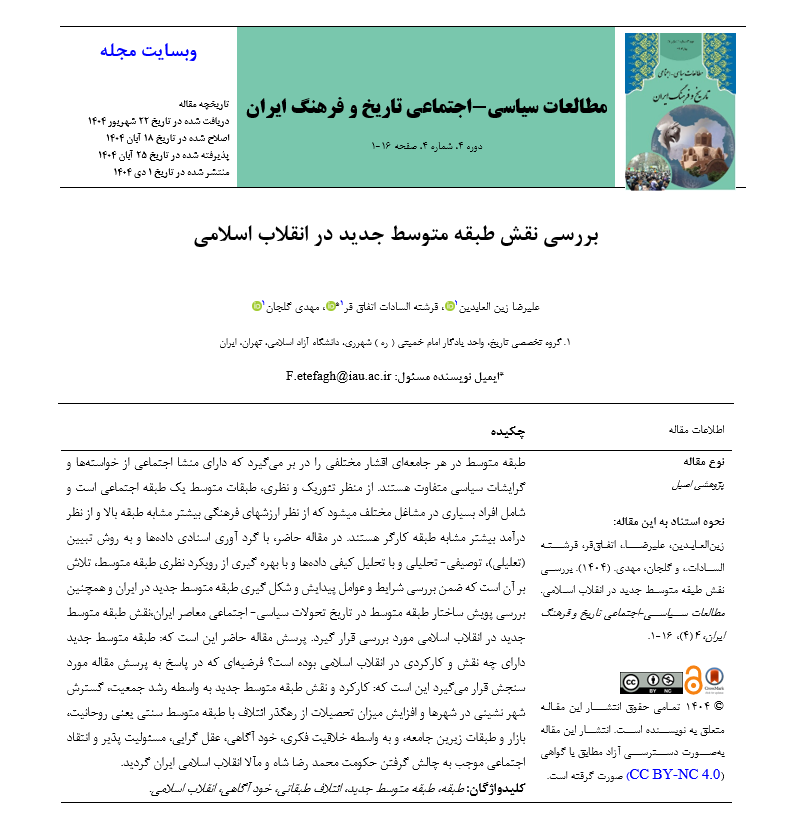
The middle class in any society encompasses various social strata that originate from different social backgrounds and possess diverse political demands and tendencies. From a theoretical and conceptual standpoint, the middle class is considered a social class that includes many individuals in various occupations who are culturally more similar to the upper class yet economically closer to the working class. In the present article, through the collection of documentary data and using an explanatory (causal), descriptive-analytical method along with qualitative data analysis, and employing the theoretical approach of the middle class, an attempt has been made to examine the conditions and factors that led to the emergence and formation of the new middle class in Iran, as well as to analyze the dynamics of the middle-class structure throughout the history of contemporary socio-political developments in Iran. Moreover, the role of the new middle class in the Iranian Islamic Revolution is explored. The research question posed in this article is: What role and function did the new middle class have in the Iranian Islamic Revolution? The hypothesis tested in response to this question states that the role and function of the new middle class—through population growth, the expansion of urbanization in cities, and the increase in education levels—by forming an alliance with the traditional middle class (i.e., the clergy, the bazaar, and the lower strata of society), and through intellectual creativity, self-awareness, rationality, responsibility, and social criticism, led to challenging the government of Mohammad Reza Shah Pahlavi and ultimately to the Iranian Islamic Revolution.
Downloads
References
Abrahamian, E. (1998). Iran Between Two Revolutions. Ney Publications.
Ashraf, A. (1993). The Social Context of Traditionalism and Modernism. Iran Nameh Journal, 15(2).
Ashraf, A., & Banuazizi, A. (1992). Social Classes in the Pahlavi Period. Rahbord Journal, 2(2).
Azghandi, A. (2000). Iran's Political Elites Between Two Revolutions. Ghumes Publications.
Azghandi, A. (2006). An Introduction to the Political Sociology of Iran. Ghumes Publications.
Bahar, M. o.-S. a. (1978). A Brief History of Political Parties. Pocket Books Joint Stock Company.
Bayat, A. (1983). Workrs Control Aftern the Revolution. Merip(113). https://doi.org/10.2307/3011074
Bendreau, A. (1999). Middle classes. Blackwell Publishers.
Grabb, E. (1994). Social Inequality: Classical and Contemporary Theorists. Moaser Publications.
Halliday, F. (1979). Dictatorship and Capitalist Development in Iran. Amir Kabir Publications.
Keddie, N. (1990). Roots of the Iranian Revolution. Ghalam Publications.
Mils, C. W. (1956). White collar: A the American Middle classes. oxford university press.
Mohammadi, M. (2006). An Analysis of the Islamic Revolution of Iran. Islamic Revolution Documents Center Publications.
Downloads
Publication Timeline
- Submitted
- Revised
- Accepted
Issue
Section
License
Copyright (c) 2025 Alireza Zeynolabedin, Fereshteh Sadat Etefaghfar, Mehdi Goljan (Author)

This work is licensed under a Creative Commons Attribution-NonCommercial 4.0 International License.