The Law of Crisis Persistence in Iran: Explaining the Cyclical Pattern of Internal and External Challenges in the Islamic Republic
DOI:
https://doi.org/10.61838/kman.jspsich.545Keywords:
crisis cycle, Islamic Republic of Iran, foreign policy, oil-based economy, centralization, participatory governance, crisis reproductionAbstract
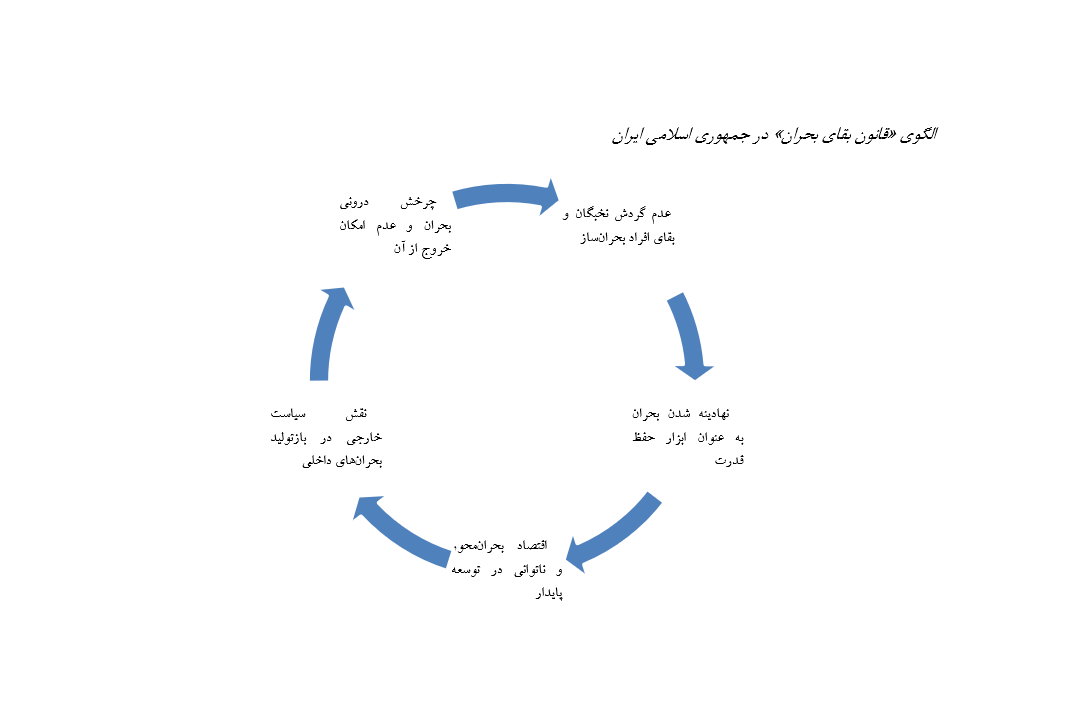
In recent decades, Iran has faced numerous domestic and external crises that have not only remained unresolved but have also been continuously reproduced within a recurring cycle. This phenomenon, which is termed the “law of crisis persistence” in the present article, results from a combination of structural, political, and economic factors that have made it difficult to break this cycle. This study seeks to identify the cyclical pattern of crises and examine the factors contributing to their persistence. It does not regard external factors as the principal variable underlying these crises. Rather, the main focus of the article is the Islamic Republic of Iran. Given the breadth of the relevant historical period, the study does not attempt to examine multiple political eras, as doing so could lead to excessive generalization. The principal research question is as follows: To what extent can the existence of a law of crisis persistence be substantiated, and what are the factors and patterns constituting this law? The findings indicate that domestic and external crises in the Islamic Republic of Iran are not merely the consequences of external forces; rather, they are produced by a recurring pattern embedded in Iran’s governance structure. These crises follow a set of factors and mechanisms that may be classified as follows: the prioritization of expediency in governance and the politicization of macro-level decision-making in the Islamic Republic; the absence of elite circulation and the continued presence of crisis-generating actors; the institutionalization of crisis as an instrument for preserving power; a crisis-oriented economy and the inability to achieve sustainable development; the role of foreign policy in reproducing domestic crises; and the internal circulation of crises and the resulting inability to escape from them. Collectively, these factors have created a pattern through which crises are successively reproduced and sustained in the Islamic Republic. Breaking this cycle is unlikely without systematically examining and addressing the aforementioned issues. The criterion used to classify these factors was their greater recurrence in comparison with other contributing variables. This study employs a descriptive-analytical method and draws on historical, economic, and political sources to examine the pattern of crises and their underlying causes.
Downloads
References
Acemoglu, D., & Robinson, J. A. (2012). Why Nations Fail: The Origins of Power, Prosperity, and Poverty. Crown Business.
Alemzadeh, M. (2023). Iran Protests and Patterns of State Repression. Iranian Studies, 56(3), 557-561.
Aslan, M., Aslan, K., & Rashid, Y. (2020). Economic and Socioeconomic Consequences of US Sanctions on Iran.
Beshkhor, M. (2021). Foreign Currency Allocation during the Sanctions Period. Economic Security Scientific Monthly, 9(10), 51-68.
Deutsche, W. (2023). Israel: Iran Gives Hezbollah in Lebanon $700 Million Annually. Deutsche Welle. https://www.dw.com
Gambrell, J. (2025). Iran Supreme Leader Criticizes Proposed Nuclear Talks with US, Upending Push to Negotiation. Associated Press.
Ghodsi, M., Astrov, V., Grieveson, R., & Stehrer, R. (2018). The Iranian Economy: Challenges and Opportunities.
Hartley, T. (2024). State Crisis Theory: A Unification of Institutional, Socio-Ecological, Demographic-Structural, World-Systems, and Revolutions Research. Cliodynamics, 15(1).
Hausmann, R., & Rodríguez, F. (2015). Understanding the Collapse: Venezuela's Experience in Cross-National Perspective. In Venezuela Before Chávez: Anatomy of an Economic Collapse (pp. 425).
Juneau, T. (2016). Iran's Policy towards the Houthis in Yemen: A Limited Return on a Modest Investment. International Affairs, 92(3), 647-663.
Khosravi, M. A., & Fard, S. S. (2016). The Ruling Elite Political Culture in Contemporary Iran. Open Journal of Political Science, 6(3), 274-283.
Lob, E. (2024). The Security-Development Nexus and the Jina Mahsa Amini Protests in Iran's Border Provinces. Iranian Studies, 57(2), 317-322.
Mohseni, E., Gallagher, N., & Ramsay, C. (2022). Iranian Public Opinion after the Protests.
Oakes, G. (2003). Max Weber on Value Rationality and Value Spheres: Critical Remarks. Journal of Classical Sociology, 3(1), 27-45.
Rafiei Bahabadi, M. (2022). A Sociological Explanation of Recent Protests: ISPA CEO Says the Accumulation of Anger Is Caused by Neglect of Demands. Islamic Republic News Agency.
Shahi, A., & Abdoh-Tabrizi, E. (2020). Iran's 2019-2020 Demonstrations: The Changing Dynamics of Political Protests in Iran. Asian Affairs, 51(1), 1-41.
Stern, E. K. (2003). Crisis Studies and Foreign Policy Analysis: Insights, Synergies, and Challenges. International Studies Review, 5(2), 183-202.
Downloads
Publication Timeline
- Submitted
- Revised
- Accepted
Issue
Section
License
Copyright (c) 2026 Ansar Amini (Corresponding Author)

This work is licensed under a Creative Commons Attribution-NonCommercial 4.0 International License.