A Comparative Study of the Religious Traditions and Beliefs of Iranians during the Qajar Era from the Perspective of French and Japanese Travel Writers
DOI:
https://doi.org/10.61838/kman.jspsich.532Keywords:
Qajar era, Travelogues, French travelers, Japanese travelers, Religious beliefsAbstract
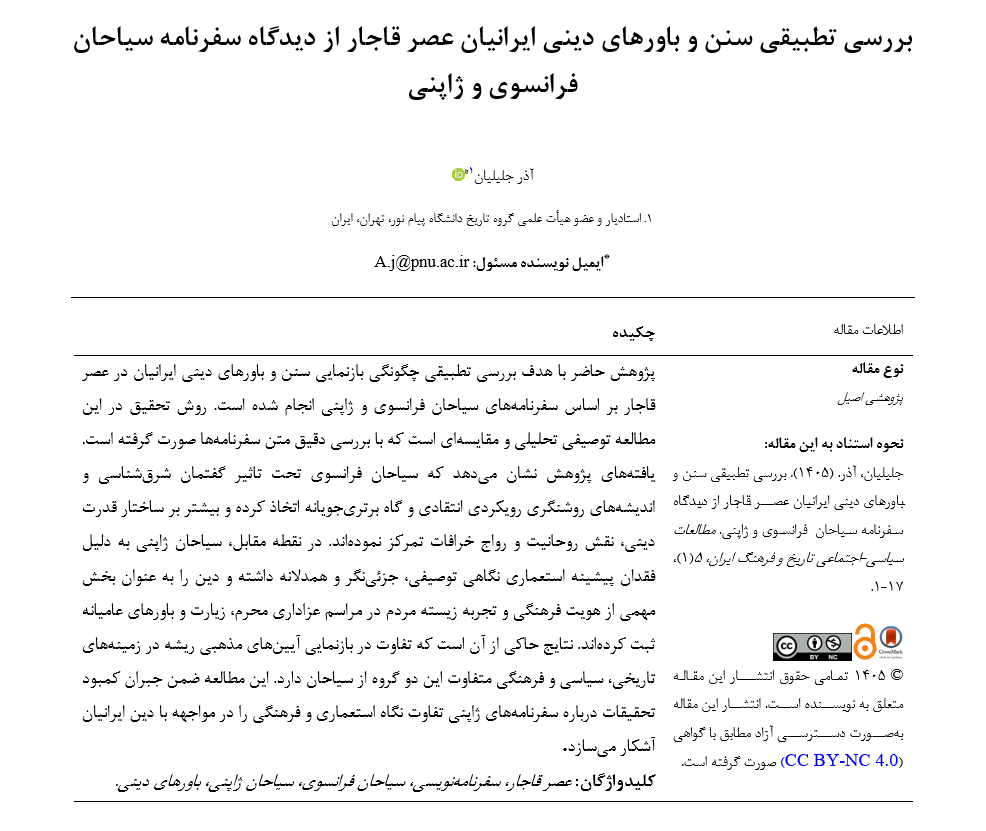
The present study was conducted with the aim of comparatively examining the manner in which the religious traditions and beliefs of Iranians during the Qajar era were represented in the travel accounts of French and Japanese travelers. The research method employed in this study is descriptive-analytical and comparative, based on a close examination of the texts of travel narratives. The findings of the study indicate that French travelers, influenced by Orientalist discourse and Enlightenment thought, adopted a critical and at times superiority-oriented approach, focusing primarily on the structure of religious power, the role of the clergy, and the prevalence of superstition. In contrast, Japanese travelers, due to the absence of a colonial background, displayed a descriptive, detail-oriented, and empathetic perspective, recording religion as an important component of cultural identity and the lived experience of the people through Muharram mourning ceremonies, pilgrimage practices, and popular beliefs. The results demonstrate that the differences in the representation of religious rituals stem from the distinct historical, political, and cultural contexts of these two groups of travelers. In addition to addressing the lack of research on Japanese travel accounts, this study reveals the distinction between colonial and cultural perspectives in encounters with the religion of Iranians.
Downloads
References
Adamiyat, F. (2006). The Ideology of the Constitutional Movement. Gostareh.
Aubin, E. (1984). Travelogue and Memoirs of Eugene Aubin, French Ambassador to Iran on the Eve of the Constitutional Movement. Elm.
Barnes, S. A. (1994). Journey to Iran in the Era of Fath-Ali Shah Qajar. Astan Quds Razavi.
Bell, G. (1984). Pictures from Iran. Kharazmi Publications.
Brugsch, H. (1993). A Journey to the Court of the Sahib-Qiran. Ettelaat Publications.
d'Allemagne, H. R. (1956). Travelogue from Khorasan to Bakhtiari. Amir Kabir.
de Sercey, E. (1984). Travelogue of Iran in the Years 1839-1840. Louheh Publications.
Dieulafoy, J. (1989). Iran, Chaldea, and Susa. University of Tehran Press.
Drouville, G. (1986). Journey in Iran. Shabaviz.
Feuvrier, J. (2005). Three Years at the Court of Iran, 1917-1920: Memoirs of Dr. Feuvrier, Personal Physician of Naser al-Din Shah Qajar. Novin.
Flandin, E. N. (1945). Eugene Flandin's Travelogue to Iran, 1841-1843. Naqsh-e Jahan.
Furukawa, N. (2005). Furukawa's Travelogue: Member of the Executive Delegation of the First Japanese Embassy to Iran during the Qajar Period. Society for the Appreciation of Cultural Works and Dignitaries.
Inoue, M., & Eura, K. (2011). Travelogue of Iran: A Japanese Traveler in Transoxiana, Iran, and the Caucasus. Tahouri.
Jones, H. (2007). Travel Diary: Memoirs of the British Mission to Iran. Sales.
Orsolle, E. (2003). Travelogue of the Caucasus and Iran. Institute for Humanities and Cultural Studies.
Polak, E. J. (1982). Polak's Travelogue: Iran and Iranians. Kharazmi.
Said, E. W. (1978). Orientalism. Pantheon Books.
Suzuki, S., & Eura, K. (2014). Travelogue of Suzuki Shinjo: Journey on the Iranian Plateau. Tahouri.
Vambery, A. (1993). The Life and Travels of Vambery. Scientific and Cultural Publishing Company.
Yenaga, T., & Eura, K. (2010). Travelogue of Yenaga Toyokichi in Iran and Anatolia. Tahouri.
Yoshida, M. (1994). Travelogue of Yoshida Masaharu. Astan Quds Razavi.
Downloads
Publication Timeline
- Submitted
- Revised
- Accepted
Issue
Section
License
Copyright (c) 2026 Azar Jalilian (Author)

This work is licensed under a Creative Commons Attribution-NonCommercial 4.0 International License.