Relationship Between the Judicial System and Social Cohesion in the Seljuk Period with Emphasis on the Reign of Sultan Malik-Shah Seljuk
DOI:
https://doi.org/10.61838/kman.jspsich.531Keywords:
Seljuks, Malik, Shah, judicial system, Dīwān al, Maẓālim, security, social cohesionAbstract
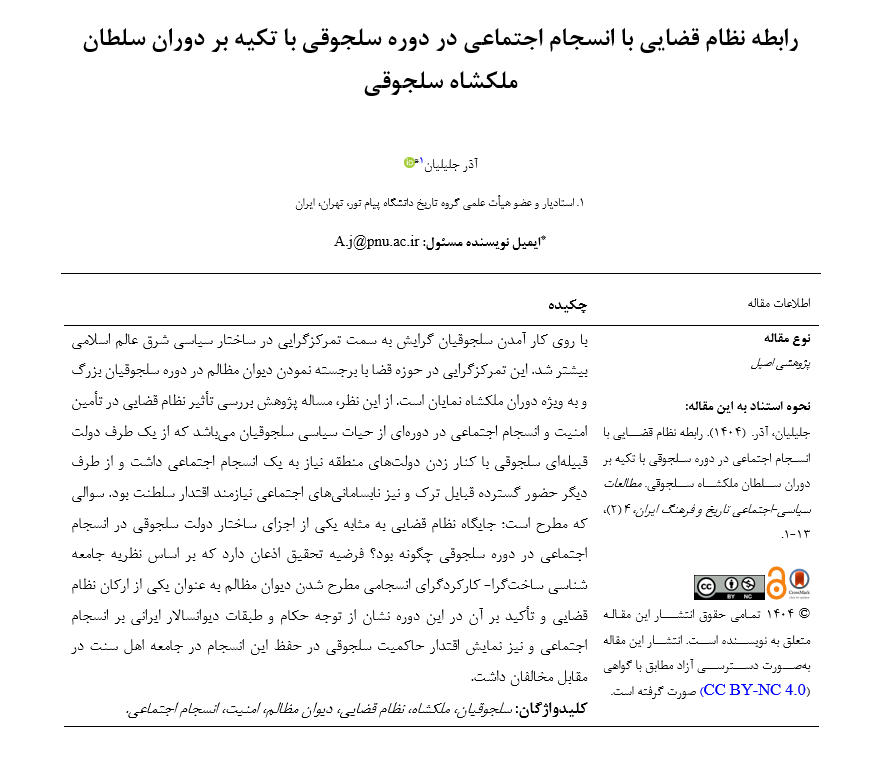
With the rise of the Seljuks, the tendency toward centralization in the political structure of the eastern Islamic world intensified. This centralization became particularly evident in the judicial sphere through the prominence of the Dīwān al-Maẓālim during the period of the Great Seljuks, especially under the reign of Malik-Shah. In this regard, the present study examines the influence of the judicial system on the provision of security and social cohesion during a phase of Seljuk political life in which, on the one hand, the tribal Seljuk state, after eliminating regional governments, required social cohesion, and on the other hand, the extensive presence of Turkish tribes as well as social disorder necessitated the assertion of royal authority. The main question addressed is as follows: what was the position of the judicial system, as one of the components of the Seljuk state structure, in establishing social cohesion during the Seljuk period? The hypothesis of the study maintains that, based on the structural-functionalist sociological theory of cohesion, the emergence of the Dīwān al-Maẓālim as one of the pillars of the judicial system and the emphasis placed upon it during this period reflected the concern of the rulers and the Iranian bureaucratic classes for social cohesion, as well as the demonstration of the authority of Seljuk rule in preserving this cohesion within Sunni society against its opponents.
Downloads
References
Al-Bandari al-Isfahani, A.-F. i. A. i. M. (1900). Kitab Tarikh Dawlat Al Seljuq. Sharikat Taba' al-Kutub al-'Arabiyya.
Al-Ghazali, A. H. M. i. M., & Shams al-Din, A. (1988). Al-Tibr al-Masbuk fi Nasihat al-Muluk (1st ed.). Dar al-Kutub al-'Ilmiyya.
Al-Ghazali al-Tusi, I. M., & Homayi, J. a.-D. (1972). Nasihat al-Muluk. National Heritage Association.
Al-Humaydi, A. a.-R. I. A. a.-A. (1989). Al-Qada wa Nizamuhu fi al-Kitab wa al-Sunnah (1st ed.). Umm al-Qura University.
Al-Khwarizmi, M. i. A. Mafatih al-'Ulum. Al-Maktaba al-Shamela. http://www.shamela.ws
Al-Mawardi, A. a.-H. A. i. H., & Ahmad, F. A. a.-M. i. (1997). Durar al-Suluk fi Siyasat al-Muluk (1st ed.). Dar al-Watan Publishing.
Al-Rawandi, M. i. A. i. S., Iqbal, M., & Minovi, M. (1954). Rahat al-Sudur wa Ayat al-Surur fi Tarikh Al Seljuq. Qaemiyeh Computer Research Center of Isfahan.
Bandari Isfahani, F. i. A., & Jalili, M. H. (1977). History of the Seljuk Dynasty: Zubdat al-Nusra wa Nukhbat al-'Usra. Bonyad-e Farhang-e Iran.
Bayhaqi, A. i. Z., & Bahmanyar, A. (1982). Tarikh-e Bayhaq. Foroughi Bookstore.
Boyle, J. A., & Anousheh, H. (2008). The Cambridge History of Iran: From the Coming of the Seljuks to the Collapse of the Ilkhanid State (7th ed., Vol. 5). Amir Kabir Publications.
Christensen, A., & Yasemi, R. (2003). Iran during the Sassanian Period (3rd ed.). Seday-e Moaser Publications.
Forouzanfar, B. a.-Z. (1973). Collection of Sermons and Speeches of Sultan al-'Ulama Baha al-Din Mohammad ibn Hossein Khatibi Balkhi (2nd ed.). Zaban va Farhang-e Iran.
Gardizi, A. S. i. A. a.-H. i. Z. i. M. (1984). Zayn al-Akhbar. Donya-ye Ketab Publications.
Hamadani, R. a.-D. F. A., Rowshan, M., & Mousavi, M. (1994). Jami' al-Tawarikh (1st ed.). Alborz Publishing.
Hassanzadeh, E. (2007). Reforms and Political Instability during the Seljuk Period. Journal of the Faculty of Literature and Human Sciences, University of Isfahan(50), 17-43.
Hosseini, S. a.-D. A. A. i. N. i. A., Nur al-Din, M., & Rouhollahi, R. A. (2001). Zubdat al-Tawarikh: Akhbar al-Umara wa al-Muluk al-Saljuqiyya (1st ed.). Il Shahsavan Baghdadi Publications.
Ibn al-Jawzi. (1978). Al-Muntazam. Al-Maktaba al-Shamela. http://www.shamela.ws
Ibn Khaldun, A. a.-R. i. M. (1971). Tarikh Ibn Khaldun. Mu'assasat al-A'lami lil-Matbu'at.
Imad al-Din al-Isfahani, M. i. M. i. H., & Murad, Y. (2004). Tarikh Dawlat Al Seljuq (1st ed.). Dar al-'Ilmiyya.
Khasbak, J. H. (1974). Judiciary in Iraq during the Seljuk Era. Al-Majalla al-Tarikhiyya(3), 81-111.
Mawardi, A. i. M., & Saberi, H. (2004). The Ordinances of Government and Religious Authorities (1st ed.). Scientific and Cultural Publications.
Moavvez, A. (1976). Judiciary during the Seljuk and Khwarazmshah Periods. Historical Studies Journal(63), 13-36.
Nezami Aruzi Samarqandi, A., & Moein, M. (1954). Chahar Maqala (3rd ed.). Zavar.
Nielen, J. S. (1991). Mazalim. In Encyclopaedia of Islam (Vol. 6). Brill.
Nishapuri, K. I. Z. a.-D. (1953). Saljuqnama. Khavar.
Shalabi, A. (1975). Tarikh al-Tashri' al-Islami wa Tarikh al-Nuzum al-Qada'iyya fi al-Islam. Maktabat al-Nahda al-Misriyya.
Tanhaei, H. A. (2010). An Introduction to Schools and Theories of Sociology (6th concise ed.). Marandiz-Bahman Barna.
Tehrani Azimzadeh, T., & Pourramazan, Z. (2011). Similarities and Differences between Judiciary and Judgment in the Seljuk Era and Pre-Islamic Periods. Specialized Quarterly of Jurisprudence and History of Civilization(26), 119-144.
Tusi, A. A. H., & Darke, H. (1968). Siyar al-Muluk (Siyasatnama) (2nd ed.). Translation and Book Publishing Organization.
Yavari, F. (1976). Divan-e Mazalim. Judicial Monthly(132), 77-87.
Zaydan, J., & Javaher Kalam, A. (1990). History of Islamic Civilization (6th ed.). Amir Kabir Publications.
Downloads
Publication Timeline
- Submitted
- Revised
- Accepted
Issue
Section
License
Copyright (c) 2025 Azar Jalilian (Author)

This work is licensed under a Creative Commons Attribution-NonCommercial 4.0 International License.