The Impact of Lifestyle on Students’ Political Orientations Using Structural Equation Modeling: A Case Study of Ahvaz
Keywords:
Lifestyle, Political Orientations, Religious Performance, Social Status, Economic StatusAbstract
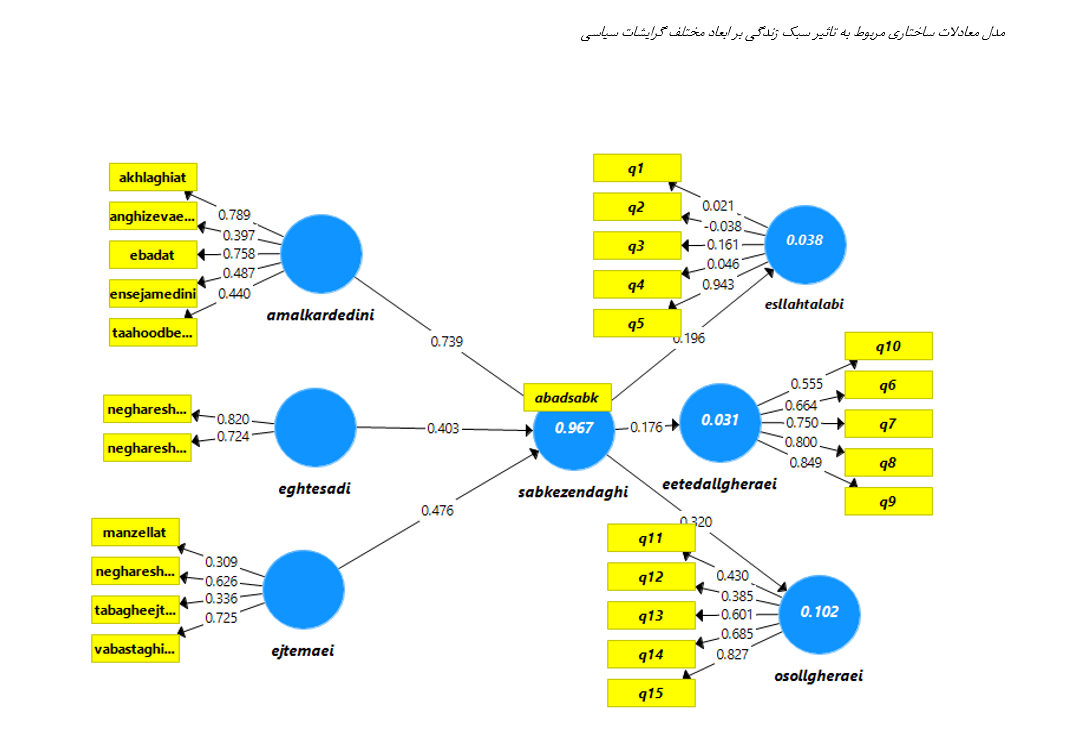
This study aims to sociologically examine the impact of lifestyle dimensions on students’ political orientations in Ahvaz . The research adopted a descriptive-survey design with an applied objective. The statistical population consisted of university students in Ahvaz, from which 384 participants were selected using stratified random sampling. Data were collected through a structured questionnaire measuring lifestyle (religious performance, social status, and economic status) and political orientations. Content validity was confirmed by experts, and reliability was established using Cronbach’s alpha coefficients above 0.78. Data analysis was conducted using Partial Least Squares Structural Equation Modeling (PLS-SEM). The results indicated that lifestyle has a significant effect on political orientations, explaining approximately 27% of their variance (β=0.275). The strongest effect of lifestyle was observed on conservatism (β=0.320), while the weakest effect was on moderation (β=0.185). Religious performance, particularly socio-religious cohesion, emerged as the strongest predictor of both conservatism (β=0.299) and reformism (β=0.310). Social status showed a significant influence on moderation (β=0.412), whereas economic status did not demonstrate a statistically significant relationship with political orientations. The findings suggest that lifestyle, as a multidimensional construct, plays a crucial role in shaping political orientations, particularly through its religious and social dimensions.
Downloads
References
Abazari, Y., & Chavoshian, H. (2002). From Social Class to Lifestyle: New Approaches in the Sociological Analysis of Social Identity. Social Sciences Letter(20).
Bennett, W. L., & Segerberg, A. (2012). The Logic of Connective Action. Cambridge University Press.
Bourdieu, P. (1984). Distinction: A Social Critique of the Judgement of Taste. Harvard University Press.
Donnelly, C. A. (2018). Digital Media, Political Participation, and the New Social Movements. New Media and Society, 20(7), 2685-2703.
Fazeli, M. (2003). Consumption and Lifestyle. Research Institute of the Ministry of Culture and Islamic Guidance.
Giddens, A. (1991). Modernity and Self-Identity: Self and Society in the Late Modern Age. Stanford University Press.
Giddens, A., & Movafaghian, N. (2003). Modernity and Self-Identity: Self and Society in the Late Modern Age (6th edition ed.). Nashr-e Ney.
Hosseinzadeh, A. H., Mavali Zadeh, E., & Moradian, K. (2014). The Effect of Internet on the Political Orientation of Students at Shahid Chamran University of Ahvaz. Social Development Quarterly, 2(9), 47-62.
Inglehart, R., & Welzel, C. (2020a). Modernization, Cultural Change, and Democracy. Cambridge University Press.
Inglehart, R., & Welzel, C. (2020b). Modernization, Cultural Change, and Democracy: The Human Development Sequence (Updated edition ed.). Cambridge University Press.
Palizban, M. (2011). Examining the Level of Students' Tendency Toward Political Participation and the Factors Affecting It. Politics Quarterly, 41(2), 33-49.
Shahriari, H. (2014). Comparative Analysis of the Political Orientation of Students at the University of Tehran. Journal of Political Knowledge, 2(20), 63-101.
Tajfel, H., & Turner, J. C. (1986). The Social Identity Theory of Intergroup Behavior. In S. Worchel & W. G. Austin (Eds.), Psychology of Intergroup Relations. Nelson-Hall.
Warde, A. (2017). Consumption: A Sociological Analysis. Palgrave Macmillan.
Downloads
Publication Timeline
- Submitted
- Revised
- Accepted
Issue
Section
License
Copyright (c) 2025 Maryam Rahdarzadeh, Hasan Kheiri, Bahram Nikbakhsh (Author)

This work is licensed under a Creative Commons Attribution-NonCommercial 4.0 International License.