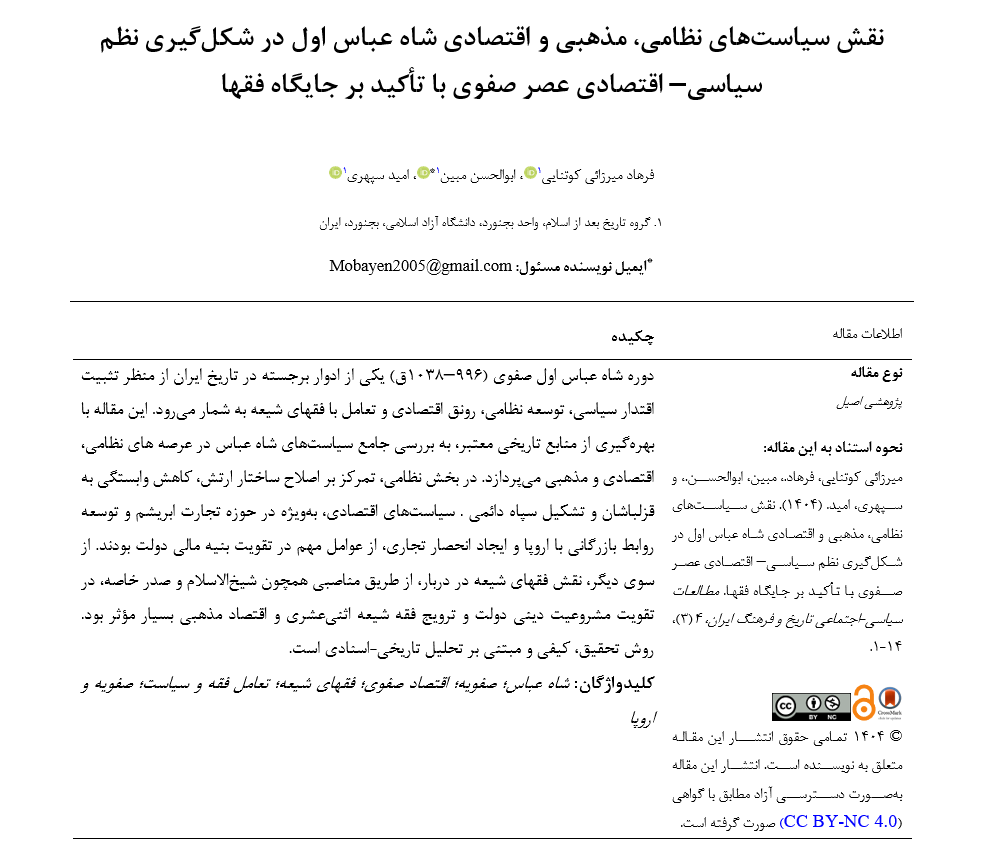
The Role of the Military, Religious, and Economic Policies of Shah Abbas I in Shaping the Political–Economic Order of the Safavid Empire with an Emphasis on the Position of Shiʿa Jurists
Keywords:
Shah Abbas, Safavid, Safavid economy;, Shiite jurists, interaction of jurisprudence and politics, Safavid and EuropeAbstract
The reign of Shah Abbas I of the Safavid dynasty (1588–1629 CE) is regarded as one of the most prominent periods in the history of Iran, in terms of consolidating political authority, expanding the military, fostering economic prosperity, and engaging with Shiʿa jurists. Drawing on credible historical sources, this article provides a comprehensive analysis of Shah Abbas’s policies in the military, economic, and religious domains. In the military sphere, the focus was on reforming the structure of the army, reducing dependence on the Qizilbash, and establishing a standing army. Economic policies, particularly in the field of silk trade, developing commercial relations with Europe, and creating trade monopolies, were among the key factors strengthening the state’s financial foundations. Moreover, the role of Shiʿa jurists at the royal court—through offices such as Shaykh al-Islām and Ṣadr-i Khāṣṣa—was highly influential in reinforcing the religious legitimacy of the state and promoting Twelver Shiʿi jurisprudence and the religious economy. The research method is qualitative and based on historical-documentary analysis.
Downloads
References
Afandi Isfahani, M. A. (2010). Riyad al-'Ulama' wa Hiyad al-Fudala' (Vol. 3). Najafi Islamic Research Foundation.
Afshar, I. (2008). Iranian Culture (Vol. 14). Sokhan Publications.
Bastani Parizi, M. E. (1999). Politics and Economy of the Safavid Era. Safi Alishah.
Bondarevsky, G. (1982). The Aspirants and the Imperialists in the Persian Gulf. Aboureihan.
Chalabi, E. (1959). Siyahatnameh.
Chardin, J. (2001). Travelogue.
Cohen, J. S. (1973). Economics, Politics, and History: Latin American Essays. MIT Press.
della Valle, P. (2001). Travelogue (Vol. 1). Qatreh Publications.
Falsafi, N. (1963). Iran's Foreign Policy in the Safavid Period. Pocket Books Organization.
Falsafi, N. (1992). The Life of Shah Abbas I (Vol. 3). Ilmi Publications.
Floor, W. (1977). The First Iranian and Dutch Ambassadors. Tahouri.
Floor, W. (2000). The Persian Gulf: The Rise of the Gulf Arabs. Mage Publishers.
Foran, J. (1994). Fragile Resistance: Social Transformation in Iran from 1500 to the Revolution. Westview Press.
Lambton, A. K. S. (1980). State and Government in Medieval Islam. Oxford University Press.
Matthee, R. (1999). The Politics of Trade in Safavid Iran: Silk for Silver, 1600-1730. Cambridge University Press.
Modarresi Tabatabaei, S. J. f. (1995). The School in the Process of Evolution. Sama Cultural Institute.
Monajjem, M. J. a.-D. (1987). Tarikh-e Abbasi or Rooznameh-ye Molla Jalal. Vahid.
Motahari, M. (2000). Velayat-e Faqih (Guardianship of the Islamic Jurist). Sadra.
Olearius, A. (1984). Travelogue. Ebtekar.
Qomi, M. T. i. M. H. (1998). Mounes al-Abrar: In Refutation of the Sufis The Islamic Heritage of Iran (Vol. 7). Ayatollah al-Uzma Marashi Najafi Library.
Qomi, Q. A. i. S. a.-D. a.-H. a.-H. (2004). Khulasat al-Tavarikh (Vol. 2). Tehran University.
Rahimzadeh, S. (1962). The Life of Shah Ismail. Khayyam Publications.
Roemer, H. R. (2006). Iran on the Way to a New Era. Tehran University.
Safa, Z. (1989). The Socio-Political-Cultural History of Iran. Amir Kabir.
Savory, R. M. (2006). Iran in the Safavid Age. Nashr-e Markaz.
Scott, J. C. (1998). Seeing Like a State: How Certain Schemes to Improve the Human Condition Have Failed. Yale University Press.
Shishehchi, H. (2005). The Role of the Persian Gulf Ports in Safavid Trade. Persian Gulf Studies, 1(6), 90-108.
Tajbakhsh, A. (1993). History of the Safavids. Navid Publications.
Taremi, H. (1996). Allameh Majlesi. Negah-e Now.
Tavernier, J.-B. (1990). Travelogue (Vol. 4). Sanai.
Tilly, C. (1990). Coercion, Capital, and European States, AD 990-1990. Basil Blackwell.
Torkaman, E. B. (1971). Alam Ara-ye Abbasi (Vol. 2). Golshan Publications.
Weber, M. (1978). Economy and Society: An Outline of Interpretive Sociology. University of California Press.
Weber, M. (2005). Economy and Society. Akhtaran Publications.
Zarrinkoub, A. (2006). In Search of Sufism in Iran. Amir Kabir.

Downloads
Published
Submitted
Revised
Accepted
Issue
Section
License
Copyright (c) 2025 Farhad Mirzaeiikoutenaei (Author); Abolhassan Mobyeen (Corresponding Author); Omid Sepehri (Author)

This work is licensed under a Creative Commons Attribution-NonCommercial 4.0 International License.