A Paradigmatic Reflection on the Concept of Social Consensus
DOI:
https://doi.org/10.61838/kman.jspsich.4.1.1Keywords:
Paradigm, structure, pattern, process, social harmonyAbstract
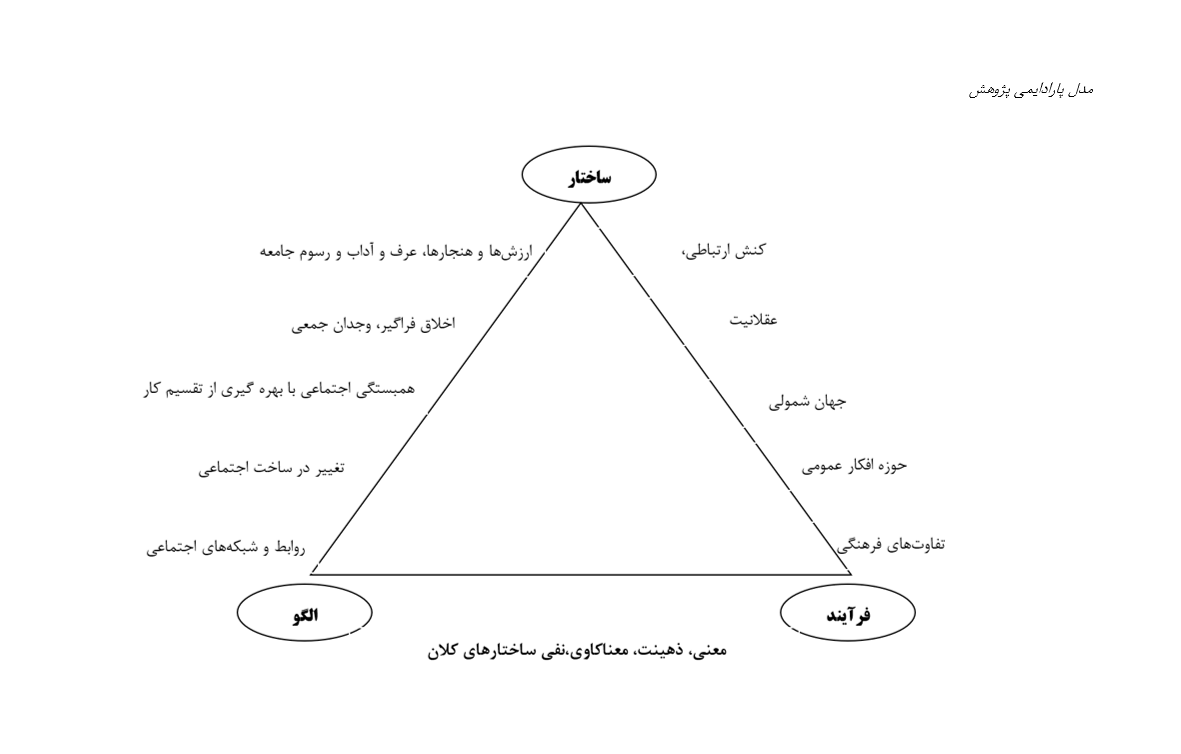
The primary objective of this article is to provide a theoretical and paradigmatic explanation of the concept of social consensus and to present a paradigmatic model for analyzing social consensus from the intersection of structure, pattern, and process. In this regard, an attempt was first made to examine the concept of social consensus from the perspective of classical and contemporary social science theorists such as Durkheim, Parsons, and Habermas, exploring structural, functional, conflictual, and communicative dimensions. Subsequently, the concept of social consensus was analyzed from epistemological, ontological, and methodological dimensions, utilizing various paradigms prevailing in social sciences along with their theoretical developments. This was done to address the fundamental question of whether social science constructs are based on a specific paradigm or a paradigm plurality, and to respond to the alignment of schools of thought and paradigms in opposition to each other, as well as the ability of social constructs to address political stability, social order, predictability of social behavior, and social interactions—each of which presents its own theoretical and methodological challenges from which the concept of consensus is not exempt. The research method employed in this study is descriptive-explanatory, with data collection conducted through library research.
Downloads
Downloads
Publication Timeline
- Submitted
- Revised
- Accepted
Issue
Section
License
Copyright (c) 2025 بهرام سرمست (نویسنده مسئول)

This work is licensed under a Creative Commons Attribution-NonCommercial 4.0 International License.