The Relationship Between Public Policy in the Domain of Public Economic Law Policy
DOI:
https://doi.org/10.61838/kman.jspsich.3.3.1Keywords:
Public Policy, Economic Policy, EconomicsAbstract
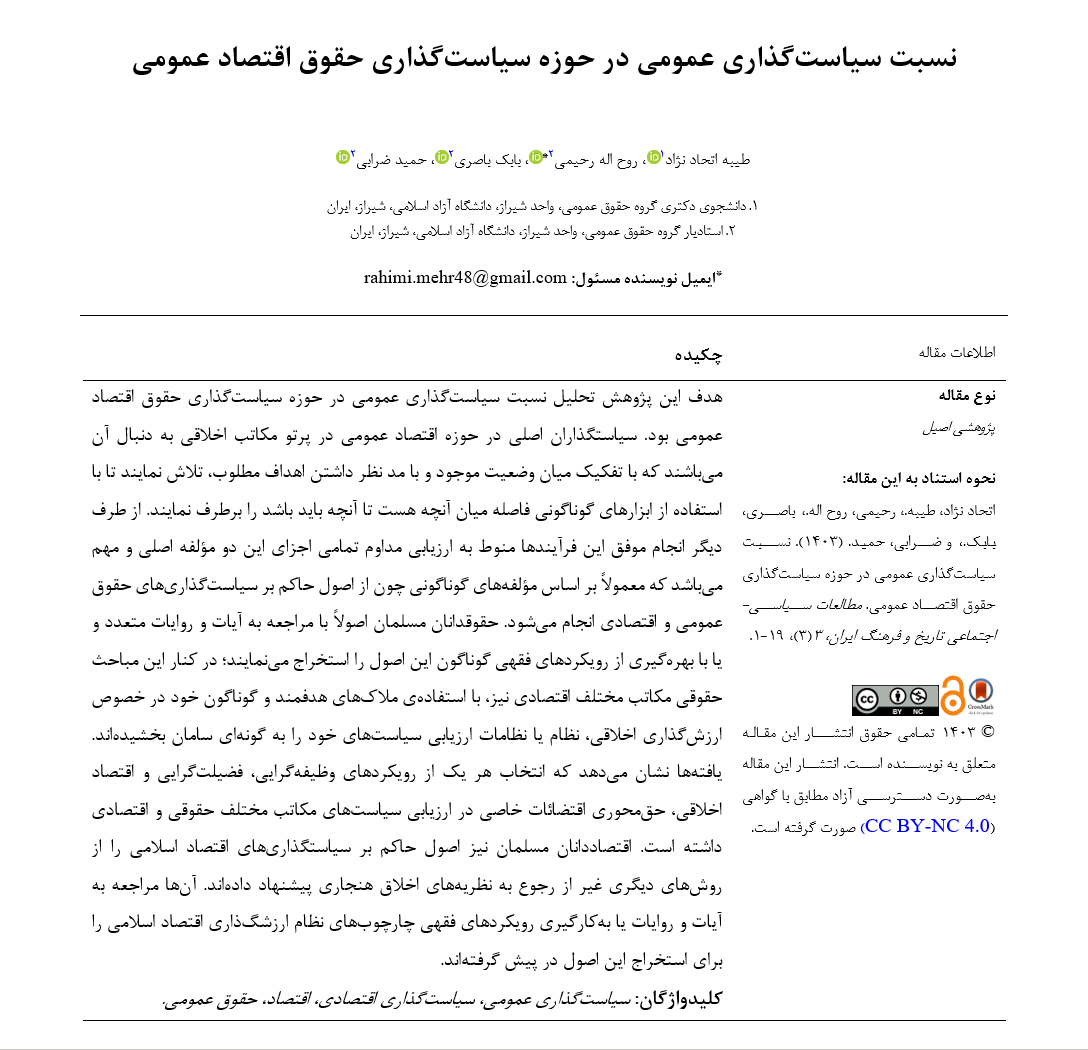
The objective of this research was to analyze the relationship between public policy in the domain of public economic law policy. The primary policymakers in the field of public economics, in light of ethical schools of thought, aim to distinguish between the current state and desired goals. They strive to bridge the gap between what is and what should be by utilizing various tools. On the other hand, the successful implementation of these processes depends on the continuous evaluation of all components of these two main and significant factors, which is typically carried out based on various elements such as the governing principles of public law and economic policy. Muslim jurists generally extract these principles by referring to numerous Quranic verses and Hadiths or by utilizing different jurisprudential approaches. In addition to these legal discussions, various economic schools have also structured their systems of policy evaluation using their own targeted and diverse criteria regarding moral valuation. The findings indicate that choosing any of the approaches—deontology, virtue ethics, or ethical economics—has specific implications for evaluating the policies of different legal and economic schools. Muslim economists, as well, have proposed other methods, aside from normative ethical theories, to derive the governing principles of Islamic economic policies. They have adopted frameworks of Islamic economic value systems based on referencing Quranic verses, Hadiths, or employing jurisprudential approaches to extract these principles.
Downloads
Downloads
Publication Timeline
- Submitted
- Revised
- Accepted