ضعف همبستگی نخبگان سیاسی پس ازانقلاب اسلامی ایران زمینهها و پیامدها
کلمات کلیدی:
نخبگان سیاسی, بحران همبستگی, انقلاب اسلامی, واگرایی نخبگانچکیده
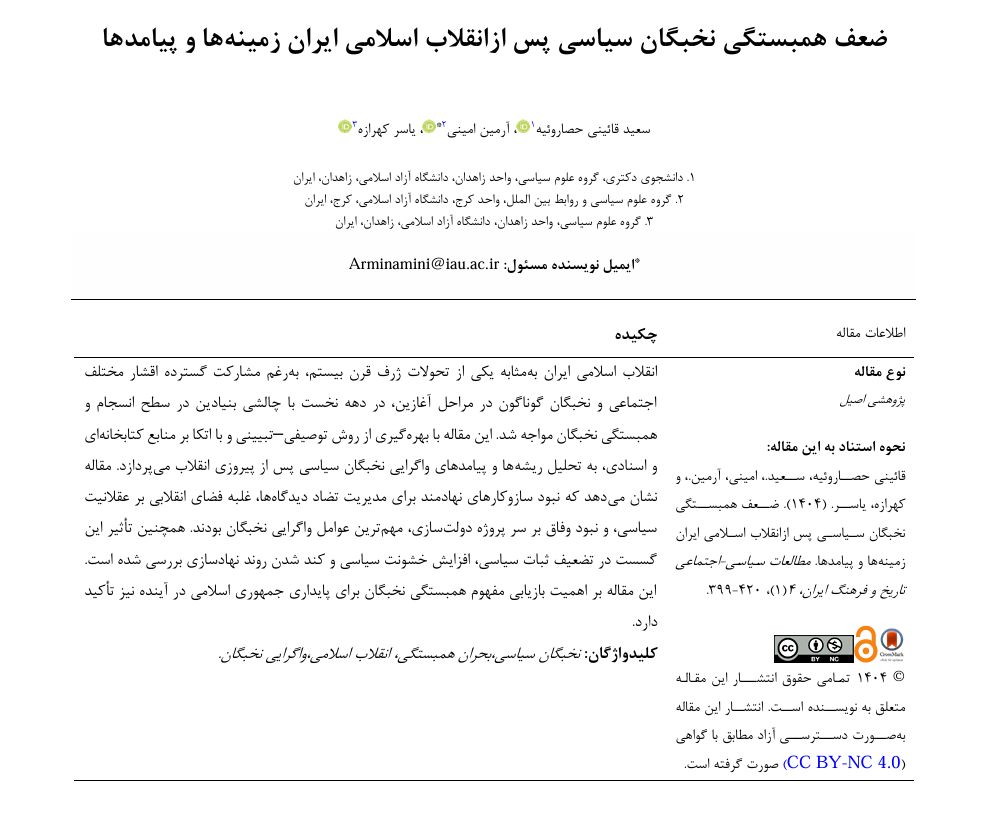
انقلاب اسلامی ایران بهمثابه یکی از تحولات ژرف قرن بیستم، بهرغم مشارکت گسترده اقشار مختلف اجتماعی و نخبگان گوناگون در مراحل آغازین، در دهه نخست با چالشی بنیادین در سطح انسجام و همبستگی نخبگان مواجه شد. این مقاله با بهرهگیری از روش توصیفی–تبیینی و با اتکا بر منابع کتابخانهای و اسنادی، به تحلیل ریشهها و پیامدهای واگرایی نخبگان سیاسی پس از پیروزی انقلاب میپردازد. مقاله نشان میدهد که نبود سازوکارهای نهادمند برای مدیریت تضاد دیدگاهها، غلبه فضای انقلابی بر عقلانیت سیاسی، و نبود وفاق بر سر پروژه دولتسازی، مهمترین عوامل واگرایی نخبگان بودند. همچنین تأثیر این گسست در تضعیف ثبات سیاسی، افزایش خشونت سیاسی و کند شدن روند نهادسازی بررسی شده است. این مقاله بر اهمیت بازیابی مفهوم همبستگی نخبگان برای پایداری جمهوری اسلامی در آینده نیز تأکید دارد.
دانلودها
مراجع
Abdi, A. (2004). An Examination of the Causes of Elite Cleavages in the Power Structure of the Islamic Republic of Iran. Institute for Development Studies.
Abedi, M. (2016). Political Cleavages and Their Consequences in Iran's Power Structure. Policy Research Quarterly.
Alavitabar, S. (2015). The Sociology of Power Cleavages in Post-Revolutionary Iran. Tarh-e No Publishing.
Alavitabar, S. (2019). An Analysis of Elite Cleavages During Rouhani's Second Administration. Siasatnameh Quarterly, 4(2).
Bashiriyeh, H. (1998). Sociology of Political Elites. Negah-e Moaser Publications.
Bashiriyeh, H. (2001). The Transformation of Political Thought in Iran. Ney Publishing.
Bashiriyeh, H. (2018). The Decline of Elites and the Turn of Discourses in the Islamic Republic. Ney Publishing.
Beetham, D. (1991). The Legitimation of Power. Palgrave Macmillan.
Burton, M., & Higley, J. (1987). Elite Settlements and the Stability of Democracies. American Sociological Review, 52(2), 295-307.
Fakouhi, N. (2011). Political Anthropology. Ney Publishing.
Fazeli, N. (2011). Generational and Elite Cleavages in Contemporary Iran. Iranian Cultural Research Quarterly, 4(2).
Fazeli, N. (2017). Culture and Politics in Iran. Tisa Publishing.
Ghaderi, M. (2004). Elites and Politics in Iran After the Revolution. Institute for Cultural Studies and Research.
Hashemi, F. (2019). Functional Legitimacy of Government and Governance Challenges. Rahbord Quarterly.
Hateminejad, S. H. (2010). A Sociological Analysis of the Process of Elite Cohesion and Divergence in the Islamic Republic of Iran. Strategic Studies of public policy, 1(1).
Kadivar, M. (2011). Revisiting Fundamental Cleavages in the Power Structure. Cheshmandaz-e Iran(69).
Kamali, H. (2017). State, Society, and Development in Iran. Institute for Strategic Studies.
Katouzian, M. A. (2013). The Political and Social Structure of Contemporary Iran. Elm Publishing Center.
Kazemi, H. (2017). A Comparative Analysis of Political Elites in Post-Revolutionary Iran. Political Science Research Journal.
Kazemi, R. (2018). A Genealogy of Power Dualities in the Islamic Republic. Iran Today Quarterly(42).
Khezri, H. (2012). Politics and Elites in the Islamic Republic of Iran. Research Institute for Islamic Culture and Thought.
Linz, J. J., & Stepan, A. (1996). Problems of Democratic Transition and Consolidation: Southern Europe, South America, and Post-Communist Europe. Johns Hopkins University Press.
Montazeri, M. (2021). Developments in the Rouhani Administration and the Paradoxes of Elite Cleavages. Strategic Policy Studies(61).
Nasri, N. (2012). Ahmadinejad's Justice-Oriented Discourse and Its Conflict with Traditional Elites. Political Science Research Journal(52).
Pareto, V. (1968). The Rise and Fall of Elites. Transaction Publishers.
Putnam, R. D. (1993). Making Democracy Work: Civic Traditions in Modern Italy. Princeton University Press.
Sadeghi, M. (2019). Legitimacy Crisis and Elite Cleavages in the Moderation Government. Iranian Policy Research Quarterly, 5(1).
Saei, A. (2008). Obstacles to Political Cohesion in the Post-Revolutionary Power Structure. Islamic Revolution Studies, 5(18).
Saei, A. (2014). Discourse Analysis of Elite Cleavages in the Ninth and Tenth Administrations. Strategic Studies of public policy, 2(4).
Tajik, M. R. (2002). Political Elites and Social Cleavages. Political Science Quarterly(16).
Tajik, M. R. (2008). The Discourse of Political Elites After the Islamic Revolution of Iran. Ney Publishing.
Tajik, M. R. (2019). Transformation of Dominant Discourses and Its Consequences for Elite Cohesion. Quarterly Journal of Political and Social Studies of Contemporary Iran(3).
Zarifian, G. (2021). Politics and Society in the Islamic Republic of Iran. Morvarid Publishing.
Zibakalam, S. (2013). Iranian Politics: From Khatami to Ahmadinejad. Rozaneh Publications.
دانلود
گاهشمار انتشار
- ارسال
- بازنگری
- پذیرش
شماره
نوع مقاله
مجوز
حق نشر 2025 Saeed Qaeini Hesaroyieh (Author); Armin Amini; Yaser Kahrazeh (Author)

این پروژه تحت مجوز بین المللی Creative Commons Attribution-NonCommercial 4.0 می باشد.