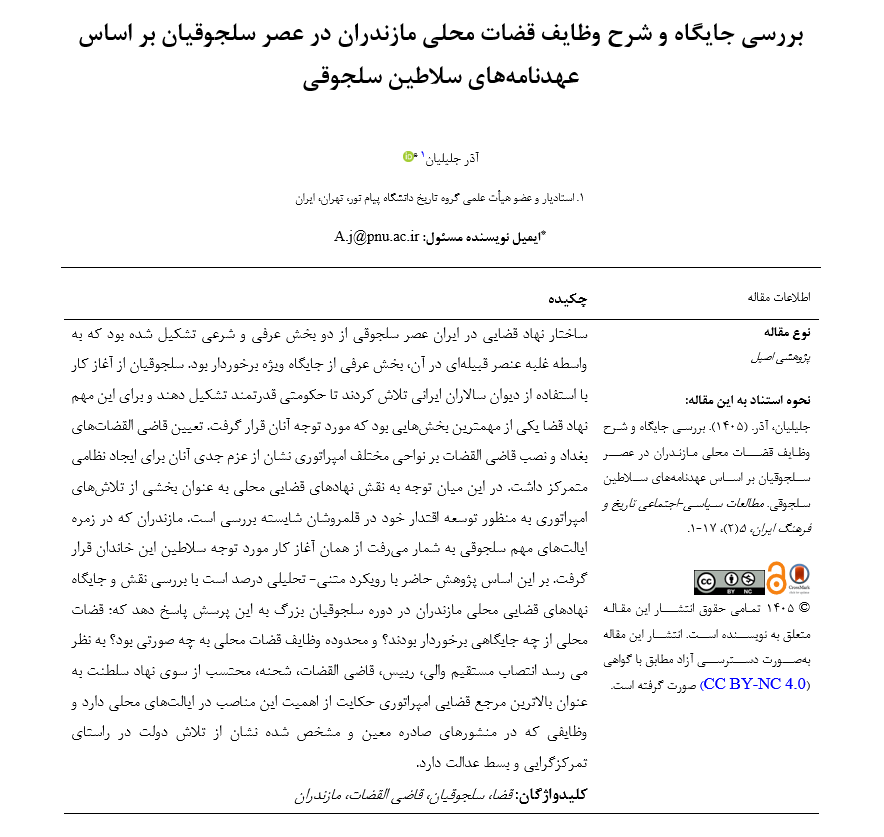
The Position and Duties of Local Judges in Mazandaran during the Seljuk Era Based on the Edicts of Seljuk Sultans
Keywords:
Judge, Seljuk, MazandaranAbstract
The structure of the judicial institution in Iran during the Seljuk period consisted of two components: customary (ʿurfī) and religious (sharʿī). Due to the predominance of tribal elements within this system, the customary branch held a particularly prominent position. From the outset, the Seljuks, by employing Iranian bureaucrats, sought to establish a powerful state, and within this framework, the judicial institution was among the most significant sectors that received their attention. The appointment of chief judges (qāḍī al-quḍāt) in Baghdad and the designation of chief judges across various regions of the empire indicate their serious determination to create a centralized system. In this context, examining the role of local judicial institutions as part of the empire’s efforts to expand its authority across its territories is of particular importance. Mazandaran, as one of the major provinces of the Seljuk state, attracted the attention of Seljuk sultans from the very beginning. Accordingly, the present study adopts a textual-analytical approach to investigate the role and position of local judicial institutions in Mazandaran during the period of the Great Seljuks, aiming to answer the following questions: What was the status of local judges? And what were the scope and nature of their duties? It appears that the direct appointment of officials such as the governor (wālī), chief (raʾīs), chief judge (qāḍī al-quḍāt), military commander (shaḥna), and market inspector (muḥtasib) by the royal institution, as the highest judicial authority of the empire, reflects the importance of these positions in local provinces. Furthermore, the duties specified and defined in the issued charters indicate the state’s efforts toward centralization and the expansion of justice.
Downloads
References
Abu, a.-F., & Ayati, A. (1970). Taqwim al-Buldan. Bonyad-e Farhang-e Iran.
Abu Zahra, M. Tarikh al-Madhahib al-Islamiyya fi al-Siyasa wa al-Aqaid wa Tarikh al-Madhahib al-Fiqhiyya. Dar al-Fikr al-Arabi.
al-Ghazali, A. H. M. i. M. i. M., & Badawi, A. a.-R. Fadaih al-Batiniyya wa Fadail al-Mustazhhiriyya.
al-Mawardi, A. i. M., & Saberi, H. (2004). The Ordinances of Government (al-Ahkam al-Sultaniyya wa al-Wilayat al-Diniyya) (1 ed.). Elmi va Farhangi.
al-Muqaddasi, S. a.-D. A. A. A. M. i. A. i. A. B. a.-B. a.-S. (1967). Ahsan al-Taqasim fi Marifat al-Aqalim (2 ed.). Brill.
al-Nasawi, M. i. A., & Hamdi, H. A. (1953). Sirat al-Sultan Jalal al-Din Mankubirti. Dar al-Fikr al-Arabi.
al-Qalqashandi, A. a.-A. A. Subh al-Asha fi Sinaat al-Insha. Al-Maktaba al-Shamela. http://www.shamela.ws
Anvari, H. (1976). Bureaucratic Terminology of the Ghaznavid and Seljuk Periods (1 ed.). Tahuri Library.
Aqsarayi, M. i. M., & Turan, O. (1983). Tarikh-i Saljuqiya or Musamarat al-Akhbar wa Musayarat al-Akhyar. Asatir.
Atabaki, M. i. B., Taher, G., & Afshar, I. (2008). Al-Mukhtarat min al-Rasail. Dr. Afshar Endowments Foundation.
Baghdadi, B. a.-D. M. i. M., & Bahmanyar, A. (2006). Al-Tawassul ila al-Tarassul. Asatir.
Bandari Isfahani, F. i. A., & Jalili, M. H. (1977). History of the Seljuk Dynasty: Zubdat al-Nusra wa Nukhbat al-Usra. Bonyad-e Farhang-e Iran.
Bayhaqi, A. a.-F. M. i. H., Fayyaz, A. A., & Yahaghi, M. J. (1976). Tarikh-i Bayhaqi. Ferdowsi University Press.
Bayhaqi, A. a.-H. A. i. Z., Qazvini, M., & Bahmanyar, A. (1982). Tarikh-i Bayhaq. Foroughi Bookstore.
Boyle, J. A., & Anousheh, H. (2008). The Cambridge History of Iran: From the Coming of the Seljuks to the Collapse of the Ilkhanid State (7 ed., Vol. 5). Amir Kabir.
Foruzanfar, B. a.-Z. (1973). Collection of Sermons and Sayings of Sultan al-Ulama Baha al-Din Muhammad ibn Husayn Khatibi Balkhi (Baha Walad) (2 ed.). Zaban va Farhang-e Iran.
Hamadani, R. a.-D. F. A., & Roshan, M. (2007). Jami al-Tawarikh: History of the Seljuks (1 ed.). Mirath-e Maktub.
Hamadani, R. a.-D. F. A., Roshan, M., & Mousavi, M. (1994). Jami al-Tawarikh (1 ed.). Nashr-e Alborz.
Husayni, S. a.-D. A. a.-H. A. i. N. i. A., Nur al-Din, M., Buniatov, Z. a.-D., Iqbal, M., & Ruhollahi, ر. ع. (2001). Zubdat al-Tawarikh, Akhbar al-Umara wa al-Muluk al-Saljuqiyya (1 ed.). Il Shahson Baghdadi.
Ibn al-Athir, I. a.-D. A. i. A., & Halat, A. (1992). Al-Kamil fi al-Tarikh: The Great Comprehensive History of Islam and Iran (Vol. 3, 4, 17). Elmi Press Institute.
Ibn al-Jawzi, A. a.-F. A. a.-R. i. A. (1939). Al-Muntazam fi Tarikh al-Muluk wa al-Umam. Matbaat Dairat al-Maarif.
Ibn Kathir al-Qurashi al-Dimashqi, A. a.-F. I. a.-D. I. i. U. (1996). Al-Bidaya wa al-Nihaya (1 ed.). Dar Abi Hayyan.
Ibn Khaldun, A. a.-R. i. M. (1971). Tarikh Ibn Khaldun (Kitab al-Ibar wa Diwan al-Mubtada wa al-Khabar fi Ayyam al-Arab wa al-Ajam wa al-Barbar wa man Asarahum min Dhawi al-Sultan al-Akbar) (1 ed.). Manshurat Muassasat al-Alami lil-Matbuat.
Ismail, S. M. (1977). Al-Tashri al-Islami (1 ed.). Maktabat al-Haram al-Makki.
Jalilian, A. (2016). The Judicial System in the Seljuk Period Payame Noor University, Qeshm International Center].
Juvayni, M. a.-D. M. a.-D. B. A., Qazvini, M., & Iqbal, A. (1950). Atabat al-Kataba: Collection of the Chancery Correspondence of Sultan Sanjar. Sherkat-e Sahami-ye Chap.
Khasbak, J. H. (1974). Al-Qada fi al-Iraq fi al-Ahd al-Saljuqi. Al-Majalla al-Tarikhiyya(3), 81-111.
Klausner, C., & Azhand, Y. (1984). Bureaucracy in the Seljuk Era. Amir Kabir.
Lambton, A. K. S., & Azhand, Y. (1993). Continuity and Change in Medieval Persia. Nashr-e Ney.
Muawwad, A. (1976). Judicial Procedure in the Seljuk and Khwarazmshah Periods. Barrasiha-ye Tarikhi(63).
Muhaysin, S. M. A. Dawlat al-Atrak al-Salajiqa, Asr al-Sultan Sanjar (1111-1160) Zagazig University, Faculty of Arts].
Qaderi, A. (2010). Ghazali's Political Thought Based on al-Mustazhiri and al-Iqtisad fi al-Itiqad. پژوهش در تاریخ, 1(1).
Rahmati, M., & Najafi, F. (2015). Examination of Seljuk Bureaucracy with Emphasis on Judicial Institutions. Tarikh-e Now(11), 119-140.
Ravandi, M. i. A., Iqbal, M., & Minovi, M. (1954). Rahat al-Sudur wa Ayat al-Surur fi Tarikh Al Seljuq. Amir Kabir.
Saket, M. H. (1986). The Institution of Adjudication in Islam. Astan Quds Razavi Press.
Schacht, J. (1991). Mahkama 1 (General). In Encyclopedia of Islam (Vol. 6). Brill.
Sedghi, N. (2009). Examination of the Structure and Nature of the Legal System of the Seljuk State. Historical Research(3).
Shabaru, I. M. (1992). Qadi al-Qudat fi al-Islam (2 ed.). Dar al-Nahda al-Arabiyya.
Tusi, A. A. H., & Darke, H. (1968). Siyar al-Muluk (Siyasatnama) (2 ed.). Bongah-e Tarjomeh va Nashr-e Ketab.
Yaqut al-Hamawi al-Rumi al-Baghdadi, S. a.-D. A. A. A. i. A. A. (1977). Mujam al-Buldan (Vol. 5). Dar Sadir.
Yusefi Far, S., & Azadeh, S. (2011). The Office of Rais in the Cities of the Seljuk Period and Their Local and Social Connections. Studies in Cultural History, 2(8).
Yusefi Far, S., Jalilian, A., Khosrobigi, H., & Razavi, S. A. (2016). Historical Reconsideration of the Diwan al-Mazalim in the Middle Period and Its Political Function in the Era of the Great Seljuks. پژوهشهای تاریخی ایران و اسلام(19).
Zuhayri Nishapuri, K. I., Afshar Hamid al-Mulk, M. I., & Ramazani, M. (2011). Saljuqnama together with the Appendix of Abu Hamid Muhammad ibn Ibrahim. Asatir.

Downloads
Published
Issue
Section
License
Copyright (c) 2025 Azar Jalilian (Corresponding Author)

This work is licensed under a Creative Commons Attribution-NonCommercial 4.0 International License.