Analysis of the Dimensions of the Continuity of Zoroastrian Presence along the Shores of the Persian Gulf from the Beginning of the Sasanian Period to the End of the Buyid Era
Keywords:
Zoroastrians, Persian Gulf, Sasanians, BuyidsAbstract
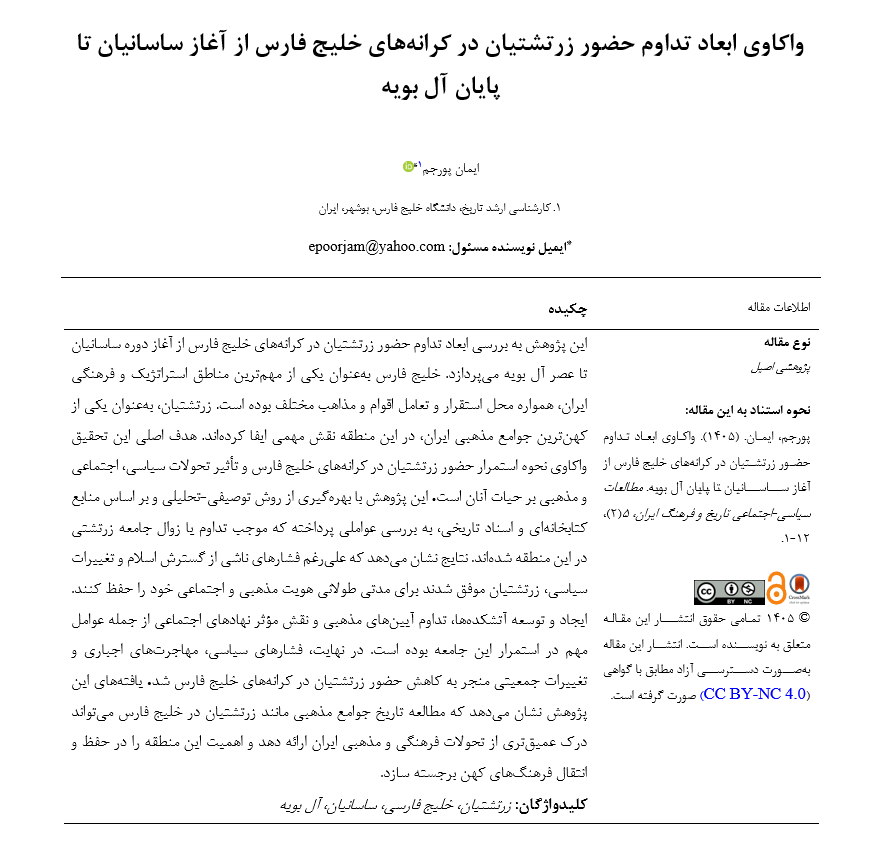
This study examines the dimensions of the continuity of Zoroastrian presence along the shores of the Persian Gulf from the beginning of the Sasanian period to the era of the Buyids. The Persian Gulf, as one of the most significant strategic and cultural regions of Iran, has consistently served as a locus for the settlement and interaction of diverse ethnic and religious groups. Zoroastrians, as one of the oldest religious communities in Iran, have played a significant role in this region. The primary objective of this research is to analyze the mechanisms underlying the continuity of Zoroastrian presence along the Persian Gulf and to assess the impact of political, social, and religious transformations on their existence. Employing a descriptive–analytical method and drawing upon library-based sources and historical documents, this study investigates the factors that contributed to either the persistence or decline of the Zoroastrian community in this region. The findings indicate that despite pressures arising from the expansion of Islam and political transformations, Zoroastrians were able to preserve their religious and social identity for a considerable period. The establishment and development of fire temples, the continuation of religious rituals, and the influential role of social institutions were among the key factors contributing to the continuity of this community. Ultimately, political pressures, forced migrations, and demographic changes led to a decline in the Zoroastrian presence along the Persian Gulf. The results of this study suggest that examining the history of religious communities such as the Zoroastrians in the Persian Gulf can provide a deeper understanding of Iran’s cultural and religious transformations and highlight the importance of this region in preserving and transmitting ancient cultures.
Downloads
References
Amouzgar, Z., & Tafazzoli, A. (1801). History of the Zoroastrian Religion. Nashr-e Daneshgahi.
Ansari, B. (2019). Analysis of the Zoroastrian Community after the Advent of Islam. Miras-e Farhangi Publications.
Choksy, J. K. (2020). Conflict and Conciliation: Zoroastrians in Iran after Islam. Ney.
Hosseini-Tabar, M. (1813). Cultural and Commercial Geography of the Persian Gulf. SAMT.
Ibn al-Balkhi. (1791). Farsnameh. Bonyad-e Farhang-e Iran Publications.
Le Strange, G. (1792). The Historical Geography of the Lands of the Eastern Caliphate. Amir Kabir.
Mojtahedzadeh, K. (1799). The Persian Gulf and Its Religious Influences in the Sasanian Period. Negah-e Moaser.
Pourjam, A. (2024). Dimensions of the Continued Presence of Zoroastrians on the Shores of the Persian Gulf from the Beginning of the Sasanian Era to the Buyids Persian Gulf University]. Bushehr.

Downloads
Published
Issue
Section
License
Copyright (c) 2025 Iman Pourjam (Author)

This work is licensed under a Creative Commons Attribution-NonCommercial 4.0 International License.